

Sly and Canned Heat at the Kaleidoscope
Hollywood
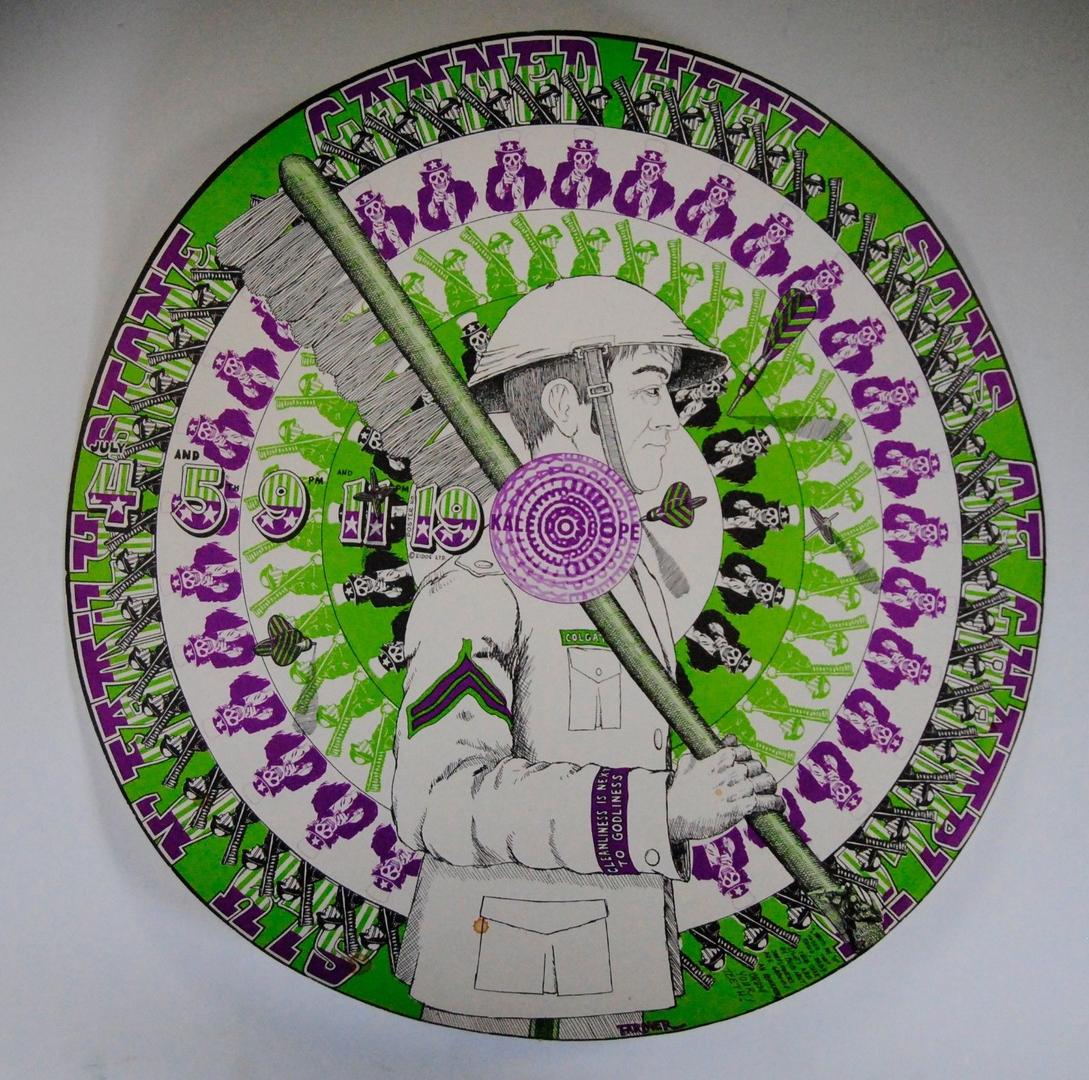
On Independence Day weekend 1968, July 4th and 5th, the Kaleidoscope at 6230 Sunset Boulevard in Hollywood hung a round poster — the venue's signature, printed circular to mirror its rotating theater-in-the-round stage — for a bill that caught two bands mid-ascent. The poster listed Sly and the Family Stone first, then Canned Heat, then the Sons of Champlin.
Sly Stone was on the cusp. "Dance to the Music" had reached number eight on the Billboard chart that April — his first Top 10, the record that announced psychedelic soul — and though the run of number ones was still months away, here he was already billed above the house band. That house band was Canned Heat, and the arrangement was literal: Canned Heat's manager Skip Taylor, their booking agent, and Gary Essert had taken over the Kaleidoscope's lease, so the boogie-blues group effectively ran the room and played it constantly. Their own breakthrough, "On the Road Again," had been released that April and was still climbing toward its eventual chart peak. Sometime that summer, across a full weekend of sets, Canned Heat rolled tape in the room for the album-length "Refried Boogie" that would fill two sides of "Living the Blues" — the same year Skip Taylor would later, to dodge a contract, pass the tape off as an old Topanga Corral recording.
The Kaleidoscope itself lasted barely six months, spring to fall 1968, inside the old Earl Carroll Theatre — the same Sunset Boulevard building that had been the Moulin Rouge and the Hullabaloo, and would soon become the Aquarius Theater, home of the Los Angeles production of "Hair." Short-lived as it was, the venue produced its own distinct series of round concert posters, the work of house artists like Dick Dahlgren and Lanning Stern — a small but genuine body of Southern California psychedelic poster art. Fittingly for this chronicle, those posters live in Paul Grushkin's "The Art of Rock" catalog itself, in the section for the psychedelic years in Southern California; the Kaleidoscope carried no numbered venue series of its own the way Bill Graham's Fillmore or the Family Dog did.
Two footnotes for the record. The Kaleidoscope's separate "Independence Day Spectacular," with Spirit headlining under a Lanning Stern poster, was July 6th, a different night. And the Doors, often mis-attached to this July 4th bill by aggregators, also played July 6th — not this weekend.
Verification Notes
Antagonist-checked deep pass (2026-07-02). CORRECTED from the prior thin entry: bill is Sly and the Family Stone / Canned Heat / SONS OF CHAMPLIN (Sons were omitted before); poster NAME-ORDER lists Sly first (do NOT assert 'Canned Heat headlined' — no source names a headliner; Canned Heat running the venue is why that's assumed). VERIFIED: round poster exists (Heritage Lot 46702; Ewbank's Lot 3151), 7/4-5/68, Kaleidoscope 6230 Sunset (former Earl Carroll Theatre -> later Aquarius/'Hair'); Canned Heat ran the venue (Skip Taylor + Gary Essert); 'On the Road Again' released Apr 1968, climbing (eventual #16 US/#8 UK); 'Refried Boogie'/Living the Blues recorded at the venue (Nov 1968 release; the Topanga-Corral mislabel story); 'Dance to the Music' #8 Apr 1968. KALEIDOSCOPE SERIES: round posters (~17-18.5', mirror the theater-in-the-round); house artists Dick Dahlgren + Lanning Stern; NO venue prefix — cataloged under AOR-/Grushkin 'Art of Rock' book, section 3 (SoCal). Doors = 7/6 NOT this bill (excluded). UNABLE-TO-CONFIRM: this poster's designer ('Farmer', Ewbank's single-source, LOW) + series# ('#19', HubPages single-source, LOW) — NOT asserted in the narrative; whether Sons played 7/4-5 vs 7/9-11 (same author contradicts himself); exact 'Refried Boogie' recording weekend; the poster's imagery. Sources: Heritage/Ewbank's, rockprosopography101 (Corry Arnold, single author — not 2 independent witnesses), Wikipedia (Canned Heat/Sly/Living the Blues/Earl Carroll), classicposters AOR index.
Were You There?
Do you have memories of this show? On This Day in Art Rock History celebrates the people who lived through the psychedelic era. Your stories and collections matter to this archive.
Comments